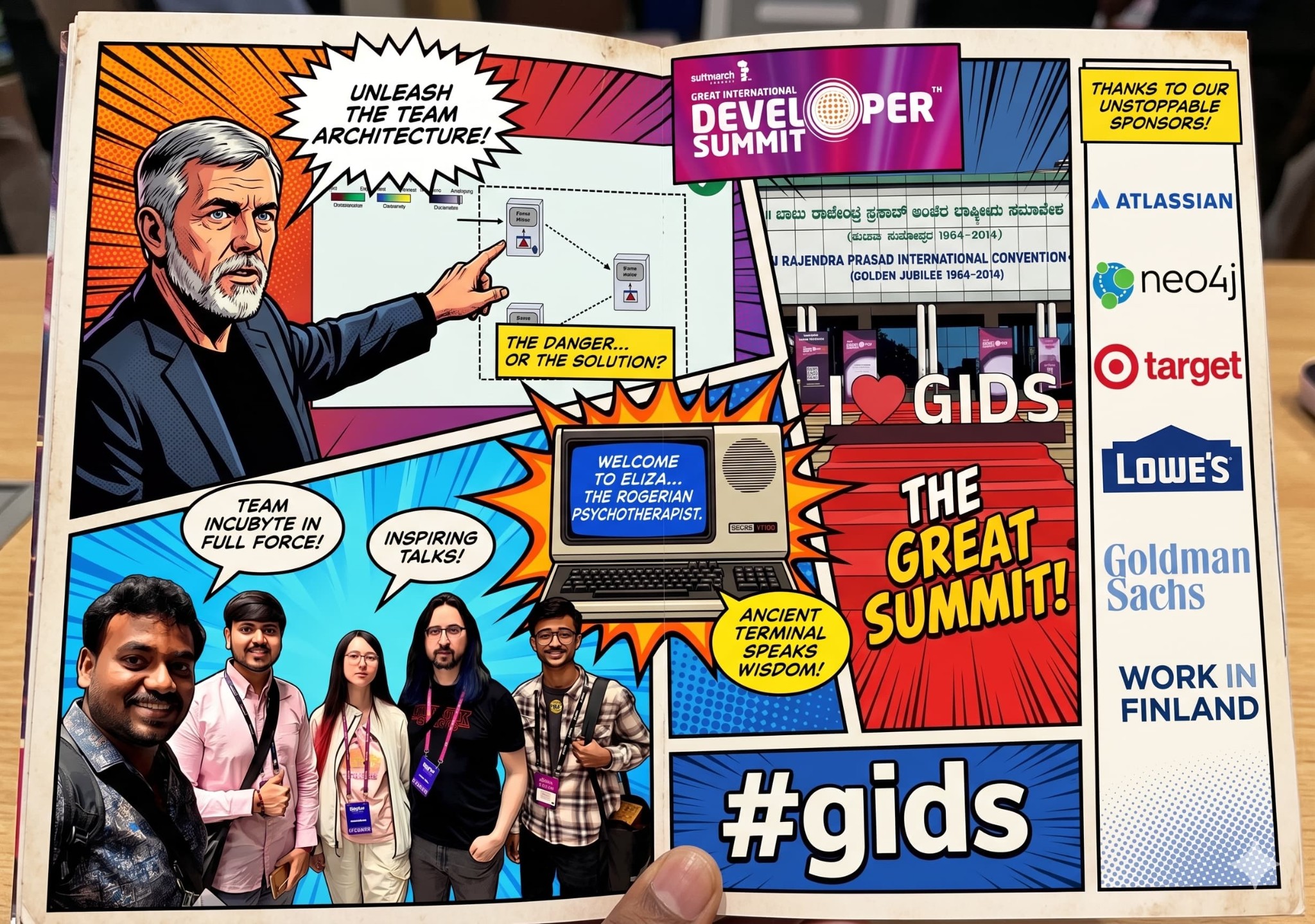
Architecture, AI, and the Power of Community: My Week at GIDS
GIDS Software Architecture Artificial Intelligence Software Craftsmanship Community Incubyte Conference LearningsGIDS in Bangalore was more than just a conference for me. It was a week filled with architecture discussions, AI conversations, expo booths, speaker interactions, and moments that genuinely made me pause and think.
As this was my first major GIDS experience, I went in with curiosity and excitement. I expected technical sessions, interesting booths, and maybe a few good takeaways. But I came back with much more than that: new perspectives, meaningful conversations, stronger confidence in the learning culture we have at Incubyte, and a deeper appreciation for what it means to keep evolving as a software craftsperson.
Starting the Week with Architecture
The first day began with Venkat Subramaniam’s keynote, “Architecting for the Unknown.”
It was the perfect way to begin the conference. The talk was simple, engaging, and very relevant. What stood out to me was the reminder that architecture is not something we should think about only after a system becomes complex. Architecture must be part of how we think while building.
In real-world projects, we rarely have complete clarity from day one. Requirements change, teams grow, product direction shifts, and systems evolve. Good architecture is not about predicting everything correctly. It is about creating systems that can adapt when the unknown eventually becomes real.
That was one of the first strong takeaways for me: architecture is not just about structure. It is about preparing for change.
Different Perspectives Matter
After Venkat’s keynote, I had a very different kind of experience with Cassandra Chin and Stephen Chin.
Their session did not connect with me in the same way Venkat’s did, but there was one part that stayed with me: the importance of teachers and early education.
It was a different point of view from most technical talks. It reminded me that technology is not shaped only by tools, frameworks, or engineers. It is also shaped by how people are introduced to learning from a young age, how curiosity is encouraged, and how teachers influence the way future builders think.
Not every session has to give a direct technical takeaway. Sometimes, a different perspective is valuable because it makes us think beyond our usual boundaries.
The Energy of the Expo
One of the most exciting parts of the first day was the expo showcase.
Since this was my first time experiencing something like this at this scale, the booths were genuinely interesting. I connected with different teams, watched demos, asked questions, and discovered companies I had not really known much about before. Some of them were big names like Lowe’s and 7-Eleven, but honestly, they were new to me in this context.
That made the expo experience even more interesting. It showed me how wide the technology ecosystem really is. We often know companies through their customer-facing brands, but seeing their engineering, platform, and innovation work gives a very different view.
And yes, collecting and winning a few goodies also made the first day more memorable.
AI, Accessibility, and Real-World Impact
Later, I planned to attend another session by Venkat, but it became more Java-focused than I expected, so I moved to Scot Davis’s talk, “You Can’t Spell Alternative Text Without AI.”
That turned out to be a good decision.
Scot Davis’s later session, “Browsing the Web with Your Eyes Closed,” also continued that theme. It made accessibility feel less like a checklist and more like a responsibility.
Architecture Kept Coming Back
Throughout the week, architecture kept appearing as a recurring theme.
Simon Martinelli’s session, “Goodbye Microservices, Hello Self-Contained Systems,” gave me a chance to think about system boundaries and whether microservices are always the right answer. It was a useful reminder that architecture choices should not be driven by trends. They should be driven by context.
Neal Ford’s keynote, “The Interaction of Architecture and AI,” was another informative session. It connected architecture with the rapidly changing AI landscape and raised important questions about how systems, teams, and design decisions may evolve in a post-AI world.
I also attended sessions around microservices granularity, communication, and “Architecture as Code.” Some of these talks felt connected to one another, and a few ideas overlapped, but the repeated theme was clear: architecture is not just about diagrams, tools, or patterns.
Graph Thinking and Familiar Fundamentals
I also attended “Graph Thinking with AI: Algorithms That Power Real Systems” by Rohit Bhardwaj.
This session brought back memories from college: DFS, BFS, graph traversal, and graph analysis. It was interesting to see those fundamentals connected back to real AI systems.
For me, the content was familiar territory and did not feel especially eye-opening, but it was still a good reminder that many modern systems are built on concepts we may have first learned years ago. Sometimes, the fundamentals we studied earlier come back in new forms.
That is also one of the reasons continuous learning matters. The basics do not disappear. They keep getting reused in new contexts.
Searching for Truth in the Age of Maybe
Day 2 started with Scot Davis’s keynote, “Searching for Truth in the Age of Maybe.”
I really enjoyed this session. The idea of maintaining a single source of truth felt very relevant, especially in the current age where information, assumptions, generated content, and interpretations can spread very quickly.
The Most Inspiring Session of the Week
The session that stayed with me the most was Michael Carducci’s “Innovation: Why the Majority Is Always Wrong.”
This was not just a technical session. It was about mindset.
There were many points that strongly resonated with me:
- Innovators can feel like loners.
- We should find our tribe.
- We should challenge the myth of the lone innovator.
- We should be careful with ego.
- Most importantly, we should not give up.
What I liked most was that the session made innovation feel human. It was not presented as something that only happens because of a breakthrough idea or a special genius. It was about persistence, courage, community, and the ability to keep going when the majority does not immediately understand the direction.
That felt powerful.
After the session, I also got a chance to connect with Michael along with the Incubyte team and invite him to SCI talks. That made the experience even more meaningful because it moved beyond just listening to a speaker. It became a real connection.
Data Architecture, AI, and Parenting Lessons
I later attended Michael’s session on data architecture for AI as well, and I liked the way it connected data thinking with the AI world.
Another memorable session was “Your AI Is Ignoring You” by Karrtik Iyer and Jem Joseph Elias. They spoke about AI, but what surprised me was how some parts connected to parenting and human behavior.
That made the session unexpectedly relatable.
Incubyte, AI, and the Post-AI World
I attended Michael’s session, “How to Be Indispensable in a Post-AI World.”
A lot of what he spoke about felt close to what we already try to do at Incubyte: learn continuously, adapt quickly, experiment with new tools, and focus on craftsmanship instead of just output.
One feeling that stayed with me throughout the conference was this: many of the conversations happening on stage around AI, learning, and adaptability were already very close to the culture we are building and practicing at Incubyte.
That made me feel proud.
Of course, there is always more to learn and improve. But the conference gave me confidence that we are moving in the right direction. In a world where AI is changing how software is built, the ability to learn, think clearly, collaborate, and adapt is becoming even more valuable.
And those are exactly the qualities we keep encouraging within our teams.
Networking, Community, and SCI
Beyond the sessions, one of my main focuses at GIDS was connecting with people.
I wanted to meet like-minded engineers, speakers, and builders. I also wanted to introduce more people to our Software Craftspersons India community.
I am happy that I was able to do that, and most of them were happy to join our community.
I had conversations with attendees, connected with speakers, spoke about the community, and shared Incubyte goodies with some of them.
A Week I Will Remember
By the end of the last day, I felt genuinely happy with how the entire GIDS experience turned out.
I learned a lot.
I had a few awe moments.
I attended sessions that made me think.
I met people I was excited to connect with.
I took photos that will stay as memories.
And I got to experience all of this with my Incubyte peers.
For me, GIDS was not just a conference week. It was a reminder of why learning matters, why community matters, and why staying curious is one of the most important qualities we can have as software professionals.
I am grateful to Incubyte for giving me this opportunity.
It was a week I will remember for a long time.